Speculative Product/feature proposal · Anthropic / Claude

Study on the Memory/Context feature of Claude and How it affects ownership of produced content
Proposal
Liminal ~ a state-awareness layer for claude.
Method
UX Research → Concept Design
Duration & Type
3 weeks
Feature Proposal | Web Design
For
Knowledge Workers & Early Career Creatives

Introduction
WHY MEMORY & CONTEXT MATTER

Give Claude Continuity
A person doesn't have to re-explain who they are, what they're working etc., every time they open a new conversation.

Gathering Perspective
That's a genuine reduction in repeated effort, and it changes how a tool feels to return to less like a blank page

Holding Declarative Facts
Knowing stated preferences, past
projects, things explicitly told. Very good at answering one question well.
Conversations & Research
24 Informal conversation cum Interviews · Early-career designers & Knowledge Workers · Directional
“It remembers I’m a UX designer. It doesn’t know I’ve rewritten this brief four times tonight and I’m not getting anywhere.”
Early-career product designer
“I use and edit memory for project all the time. That’s not the problem. The problem is I don’t notice I’ve been going in circles.”
Freelance visual designer
“Memory feels like it’s about me. What I actually want some days, is for it to notice what’s happening right now.”
Design student, final year
“It’s not that Memory doesn’t work. I got the content anyways but don't feel like I have the ownership of the same”
Knowledge worker, content design
How Things were Before Ai.
Understanding Authorship, accountability and Ownership with an example of you, baking a cake at a bakery.

Authorship
"I made it" , you mixed it, you baked it. That's Yours.

Accountability
"It's my fault if it's bad" , if it tastes like
salt, people look at you. Also yours.

Ownership
"I get the money" , Nope. The bakery owner gets that.
Authorship, is the real thing that got taken away. People I talked to mushed them together when they say "ownership."
You didn't start by inventing cakes. You started by cracking eggs. A thousand eggs. Then stirring. Then icing the same cupcake forty times until the swirl looked right.
Boring? Yes. But here's the sneaky part, while your hands were doing the boring thing, your brain was quietly learning.
And when you go through this process, what actually yours is when Someone points at your cake and asks: "Why is it lemon? Why is it small? Why no frosting on top?"
And you say: "Because it's for a summer party, and heavy frosting melts, and people were eating standing up so it had to fit in one hand."
That nobody can hand you.
TLDR : Making things used to prove you understood things. It doesn't anymore. So now you have to say what you understand, out loud.
AUTHORSHIP AFTER AI & VERDICT
Users still have the ownership, but the authorship changes, Here we talk about Affects of change in authorship and where & how it leads to.

01
02
03
Process : User Questions the process they followed to do a task traditionally
Id'ing work : Problem identifying the roots of the work/task users are doing
Loosing Task at Hand : Without even identifying, people still take accountability and feel like loosing grasp of Task.
This isn’t an awareness gap.
Users know Memory exists, Use it daily. The friction they describe survives it anyway because it was never the thing Memory was built to catch.
Pattern across Research
The consistent gap was between what Memory tracks , facts it stores, and what people actually needed any AI to notice are not in a sync.
Under the layers of authorship, accountability and ownership, What are AI's hidden limitations, the ones invisible to users, and that can't be fixed by adding memory or a longer context window:
1. Checking intent of the user.
How engaged or lost the user feel during the chat.
How do the user put up their voice during a conversation.

Problem Highlight
HOW MIGHT WE BUILD AUTHORSHIP EXPERIENCE AND IMPROVE CONFIDENCE DURING THE CHAT WITH CLAUDE
Approach
MEET THE USER

Arjun Mehta, 27
Content Designer, SaaS Startup
Two years in. Uses Claude Daily, Project, Memory and the usual works.
Frustrations
He doesn't notice he's circling until twenty minutes are gone.
Claude knows his whole resume never looks up at his face.
Aspirations
To open shipped work and still able to recognize his own voice in it.
To catch his own mode in the moment, not in hindsight.

The distinction
Key difference between current memory/context feature
VS Proposed feature i.e., Liminal
Memory
Declarative and Stored
It asks “What has this person told me?”
Memory solves “Claude doesn't remember I'm a designer.”
Liminal
Inferred and Live
It asks “What is this person’s creative state ?”
Liminal solves “Claude doesn't know I'm stuck in a loop right now.”
Key decision
A single ambient indicator, not three separate UI moments.
01
Behavioral trigger
A pattern is detected. Hesitation, repetition, or a shift in authorship ratio.
02
Signal state
The indicator shifts. Quietly present, never inserted into the conversation as an interruption.
03
Behavior route
The same component expresses Intent, Your Flow or Voice Signal depending on the live state.
ANATOMY & STATES
How does this component reads ?
One primitive, six states that are idle through resolution. This is the Liminal's state map ~ every condition it can be in.




PLACEMENT EXPLORATIONS
Where Linimal is placed ?

Near input
Highest visibility while typing but it competes with the compose box at the exact moment of input.

Sidebar
Unobtrusive, but too easy to ignore during active work, precisely when the read matters most.

Top Bar - Chosen
In the eyeline without interrupting input. Close enough to notice, far enough not to compete.
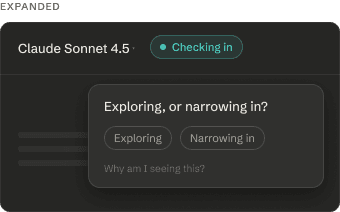
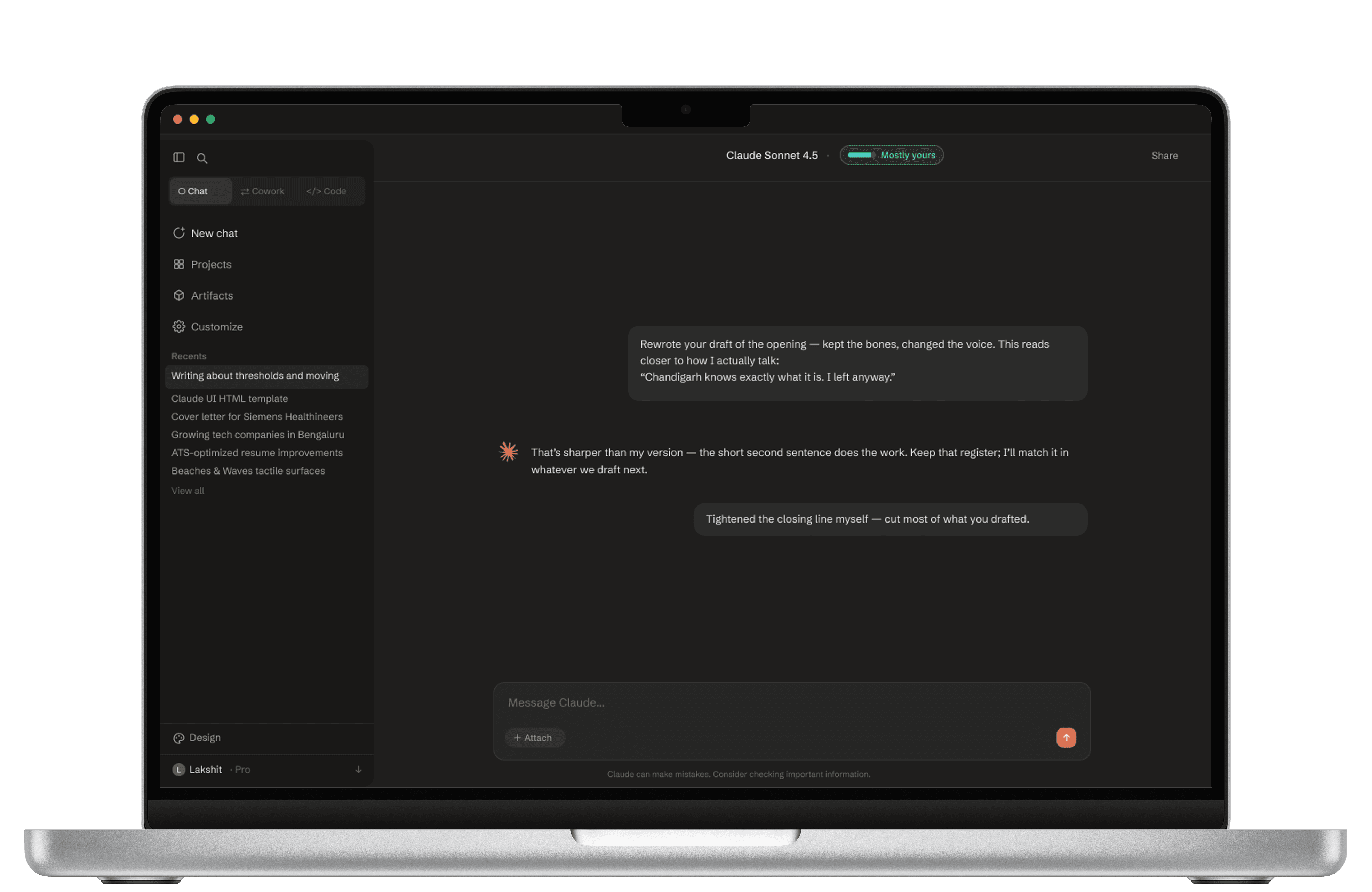
IN-context flows
Liminal , live inside Claude’s UI.
Intent Check-in (Click on arrow to preview)
Idle → signal appears → person taps → light check-in surface → dismiss

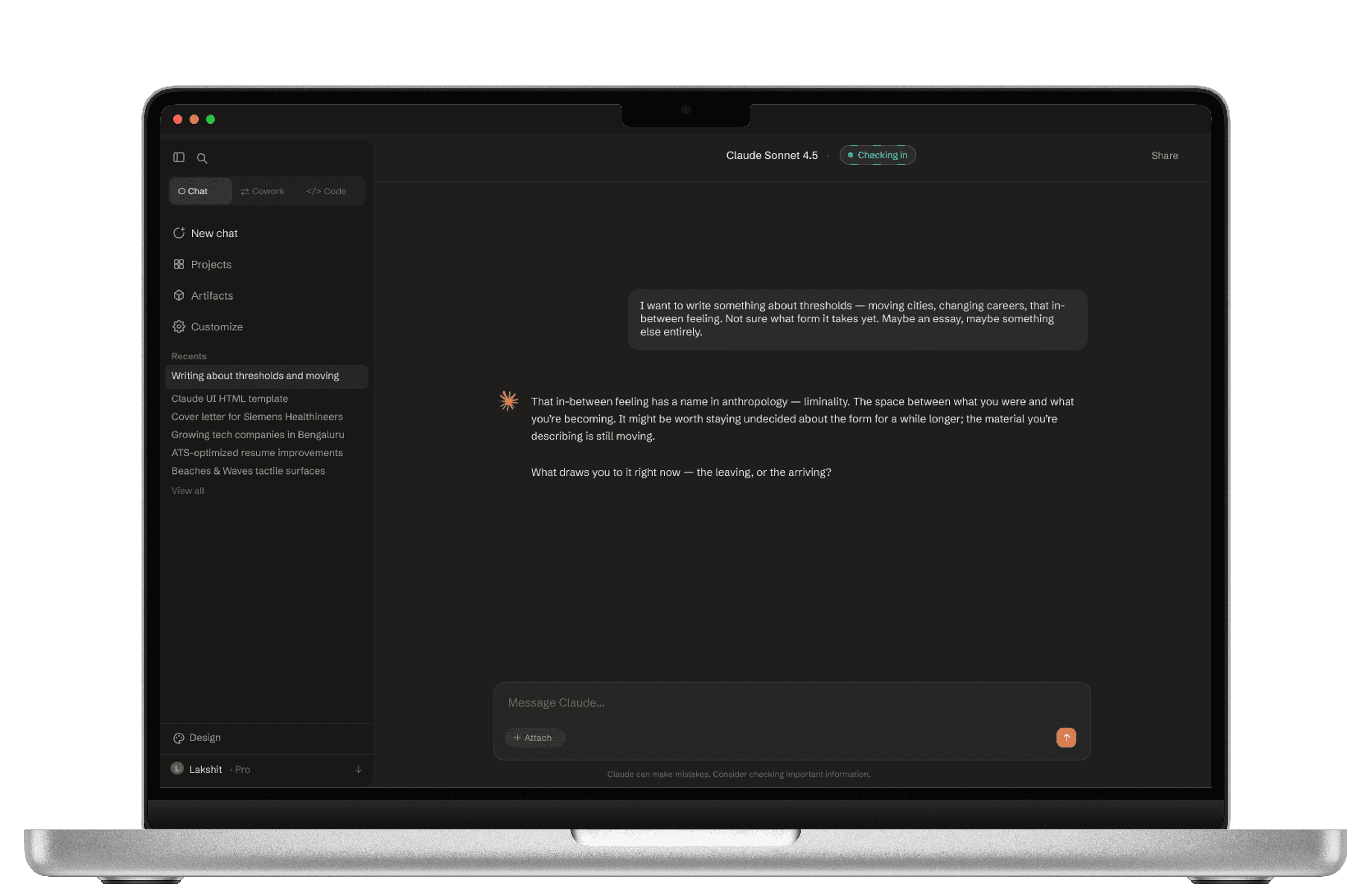


Flow Guard (Click on arrow to preview)
friction state → expand → person engages, or keeps working — both are valid outcomes


Voice Signal (Click on arrow to preview)
friction state → expand → person engages, or keeps working, both are valid outcomes.

EXPLAINABILITY
A one-line “why am I seeing this” affordance sits behind every triggered state. It builds trust in the inference, and gives the person a place to correct a wrong read, without turning any of it into stored memory.

System vbiew
Three behaviors. One signal.

Critique on Future Ahead
Will Liminal become an Obstacle or a Game Changer for Ai transparency law, such as Ai watermarking ?
Right now, I believe neither a game changer nor an obstacle. Liminal is another layer. Ai watermarking can tell 'was this machine generated?' for a third party after the fact. Liminal is reflective and private layer that might help user recognize their own work at different capacities. If you have any opinion regarding this study, please feel free to write to me on my email (See footer).
Memory made Claude someone who remembers you. Liminal is a proposal for Claude to notice you, and to say so quietly enough that noticing never gets in the way of the work.
Email :
Lakshitkumar007@gmail.com
© Copyright 2026. All Rights Reserved by Lakshit Kumar